People in the news › Profile
Viktor Yanukovych
President of Ukraine from 2010 to 2014
- Role
- President of Ukraine from 2010 to 2014
- Born
- July 9, 1950, Yenakiieve, Russian Empire
- Party
- Party of Regions
- Ideology
- communism, Marxism–Leninism, scientific socialism
- Citizenship
- Soviet Union, Ukraine, Russia
- Occupations
- engineer, economist, politician, jurist, diplomat
- Religion
- Eastern Orthodoxy
Viktor Fedorovych Yanukovych (born 9 July 1950) is a Ukrainian former politician who served as the fourth president of Ukraine from 2010 to 2014. He also served as the prime minister of Ukraine several times between 2002 and 2007 and was a member of the Verkhovna Rada (parliament) from 2006 to 2010. Yanukovych was removed from the presidency during the 2014 Revolution of Dignity, which followed months of protests against him.
Summary: Wikipedia (CC BY-SA 4.0)
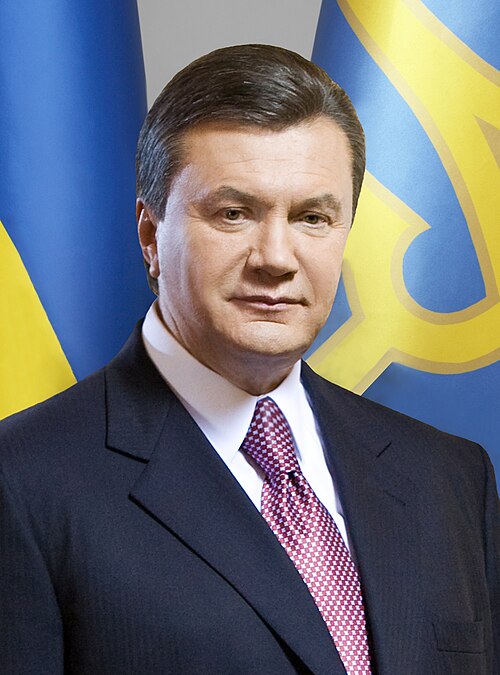
Photo: Administration of the President of Ukraine / Wikimedia Commons, CC BY 4.0. File page
Photos


Freely licensed photos from Wikimedia Commons used in the Wikipedia article about Viktor Yanukovych. Each caption names the photographer and license.
Early life
Born July 9, 1950 in Yenakiieve, Russian Empire.
Source: Wikidata Q1459658 (CC0)
Viktor Fedorovych Yanukovych was born on 9 July 1950 in Zhukovka, a village near Yenakiieve in the Donetsk Oblast of the Ukrainian SSR of the Soviet Union. Of his childhood, he has written: "My childhood was difficult and hungry. I grew up without my mother, who died when I was two.
Source: Wikipedia, “Early life and career” (CC BY-SA 4.0)
Family
- Spouse: Lyudmila Yanukovych
- Children: 2
Source: Wikidata Q1459658 (CC0)
Yanukovych was married to Lyudmyla Oleksandrivna Nastenko. The couple married in 1971. With his wife Yanukovych had two sons, Oleksandr and Viktor, and three grandsons.
Source: Wikipedia, “Personal life” (CC BY-SA 4.0)
Public information only.
Education
- Donetsk National Technical University (1980)
- Ukrainian State University of Finance and International Trade
Source: Wikidata Q1459658 (CC0)
Career and jobs
Offices and positions
- Chairman of the Council of CIS Heads of State January 1, 2014 to February 22, 2014
- President of Ukraine February 25, 2010 to February 22, 2014
- substitute member of the Parliamentary Assembly of the Council of Europe January 21, 2008 to January 20, 2013
- People's Deputy of Ukraine November 23, 2007 to February 19, 2010
- Representative of the Parliamentary Assembly of the Council of Europe October 2, 2006 to January 21, 2008
- Prime Minister of Ukraine August 4, 2006 to December 18, 2007
- People's Deputy of Ukraine May 25, 2006 to September 12, 2006
- Prime Minister of Ukraine December 28, 2004 to January 5, 2005
- Prime Minister of Ukraine November 21, 2002 to December 7, 2004
- Governor of Donetsk Oblast May 14, 1997 to November 21, 2002
- Chairman of the Donetsk Oblast Council ?
Source: Wikidata Q1459658 (CC0)
Yanukovych's political career began when he was appointed as a Vice-Head of Donetsk Oblast Administration in August 1996. On 14 May 1997, he was appointed as the Head of the Administration (i.e. Oligarch Rinat Akhmetov was widely considered to have played a key role in Yanukovych's appointment as governor.
Source: Wikipedia, “Political career: 1996–2010” (CC BY-SA 4.0)
Political ideology and goals
Party: Party of Regions (2000 to 2014); Communist Party of Ukraine (1980 to 1991); Communist Party of the Soviet Union
Ideology (Wikidata, person or party): communism, Marxism–Leninism, scientific socialism, anti-capitalism
Source: Wikidata Q1459658 (CC0)
Head of Donetsk Oblast Administration (1997–2002)
Yanukovych's political career began when he was appointed as a Vice-Head of Donetsk Oblast Administration in August 1996. On 14 May 1997, he was appointed as the Head of the Administration (i.e.
Source: Wikipedia, “Head of Donetsk Oblast Administration (1997–2002)” (CC BY-SA 4.0)
Return to government
Following the resignation of his head of administration Oleksandr Zinchenko, president Yushchenko dismissed Yulia Tymoshenko from the post of Prime Minister and appointed Yuriy Yekhanurov as head of a technocratic government which acted until the new parliamentary election.
Source: Wikipedia, “Return to government” (CC BY-SA 4.0)
Second premiership (2006–2007)
On 4 August 2006, one day after the signing of the Universal of National Unity by the majority of Ukraine's political parties, Yanukovych was appointed Prime Minister as representative of the "Anti-crisis coalition" created by the Party of Regions, the Socialist Party of Ukraine and the Communists.
Source: Wikipedia, “Second premiership (2006–2007)” (CC BY-SA 4.0)
Presidency: 2010–2014
Ukraine's parliament had (on 16 February) fixed 25 February 2010 for the inauguration of Yanukovych as president. Ukrainian president Viktor Yushchenko signed a decree endorsing a plan of events related to Yanukovych's inauguration on 20 February 2010.
Source: Wikipedia, “Presidency: 2010–2014” (CC BY-SA 4.0)
Establishment of the Azarov government
The Party of Regions and its satellites – the Communist Party of Ukraine and the Lytvyn Bloc – did not have a parliamentary majority in order to create a new government. The Ukrainian Constitution stipulated that a government should be created by a coalition of parliamentary fractions, not by individual members of parliament.
Source: Wikipedia, “Establishment of the Azarov government” (CC BY-SA 4.0)
Subordination of government branches
Within a few months, Yanukovych and his team had effectively subordinated all branches of Ukrainian government and marginalized the opposition. The new political regime was seen by some as a continuation of Leonid Kuchma's "blackmail state".
Source: Wikipedia, “Subordination of government branches” (CC BY-SA 4.0)
As reported in the Wikipedia article and its cited sources. Allegations are not findings unless a court or official body says so.
Criminal convictions
On 15 December 1967, at the age of 17, Yanukovych was sentenced to three years imprisonment for participating in a robbery and assault. On 8 June 1970 he was convicted for a second time on charges of assault.
Source: Wikipedia, “Criminal convictions” (CC BY-SA 4.0)
Vote rigging allegations
The Organization for Security and Cooperation in Europe confirmed witness accounts of voters being blocked from access to polls and being attacked along with local election officials who tried to frustrate the Berkut's practice of falsifying voters' ballots in favor of Yanukovych's Party of Regions candidates. Individual cases have been reported of citizens grouping together and fighting back against the Berkut in order to preserve election integrity and results.
Source: Wikipedia, “Vote rigging allegations” (CC BY-SA 4.0)
Reports of corruption and cronyism
Yanukovych has been criticized for "massive" corruption and cronyism. Ukraine under his rule was described as a "systemically corrupt" country.
Source: Wikipedia, “Reports of corruption and cronyism” (CC BY-SA 4.0)
Criminal cases
Since the revolution, Yanukovych has been convicted in absentia of high treason against Ukraine. He is wanted by the Prosecutor General of Ukraine, charged with responsibility for mass murder of the Maidan protesters, as well as abuse of power, misappropriation of public funds, bribery, and property theft.
Source: Wikipedia, “Criminal cases” (CC BY-SA 4.0)
Sanctions
Due to the annexation of Crimea by the Russian Federation he was put on the US sanctions list on 17 March 2014, an action which had been already previously been considered. He was sanctioned by the British government on 6 March 2014 in relation to the Russo-Ukrainian War.
Source: Wikipedia, “Sanctions” (CC BY-SA 4.0)
Fraud
On 11 July 2005, the office of the Donetsk Oblast Prosecutor charged Yanukovych with fraud, stemming from alleged irregularities in the way his convictions were expunged twenty years earlier. In 2006, the General Prosecutor closed the case due to lack of evidence.
Source: Wikipedia, “Fraud” (CC BY-SA 4.0)
Public image
Yanukovych stated that his "aim and dream" was to unify Ukraine, although in his opinion "there are already no borders between the East and West of the country today". He noted the importance of finding ways of reconciliation between Ukrainians fighting on opposite sides in World War II in his speech at the ceremony to mark Victory Day 2013. In this speech he also expressed confidence that Nazi and Soviet totalitarianism of the past would never return.
Source: Wikipedia, “Legacy of WW2” (CC BY-SA 4.0)
How they rose: timeline
Born in Yenakiieve, Russian Empire
Completes studies at Donetsk National Technical University
Joins the Communist Party of Ukraine
Becomes Governor of Donetsk Oblast (until November 21, 2002)
Joins the Party of Regions
Becomes Prime Minister of Ukraine (until December 7, 2004)
Becomes Prime Minister of Ukraine (until January 5, 2005)
Becomes People's Deputy of Ukraine (until September 12, 2006)
Becomes Prime Minister of Ukraine (until December 18, 2007)
Becomes Representative of the Parliamentary Assembly of the Council of Europe (until January 21, 2008)
Becomes People's Deputy of Ukraine (until February 19, 2010)
Becomes substitute member of the Parliamentary Assembly of the Council of Europe (until January 20, 2013)
Becomes President of Ukraine (until February 22, 2014)
Becomes Chairman of the Council of CIS Heads of State (until February 22, 2014)
Source: Wikidata Q1459658 (CC0)
BLACKOUT.NETWORK stories (1)
- A car exploded on Kirovogradskaya Street in Moscow, according to Russian media. The driver was injured, and the cause of the explosion is unNov 13, 2026 · rank 3/10
Newest first. Stories older than a week are marked Archive.
Sources
Facts in lists come from Wikidata (CC0). Quoted passages are short excerpts of the English Wikipedia article (CC BY-SA 4.0), each linked to its section, where the original citations are. BLACKOUT.NETWORK does not rank, score or rate people.