People in the news › Profile
Nelson Mandela
President of South Africa and anti-apartheid activist
- Role
- President of South Africa and anti-apartheid activist
- Born
- July 18, 1918, Mvezo, South Africa
- Died
- December 5, 2013
- Party
- South African Communist Party
- Ideology
- African nationalism, social democracy
- Citizenship
- South Africa
- Occupations
- politician, autobiographer, lawyer, political activist, political prisoner
- Religion
- Methodism
Nelson Rolihlahla Mandela (18 July 1918 – 5 December 2013) was a South African anti-apartheid revolutionary, politician, and philanthropist, who served as President of South Africa from 1994 to 1999. He was the country's first black head of state and the first elected in a fully representative democratic election. His government focused on dismantling the legacy of apartheid by tackling institutionalised racism and fostering racial reconciliation.
Summary: Wikipedia (CC BY-SA 4.0)
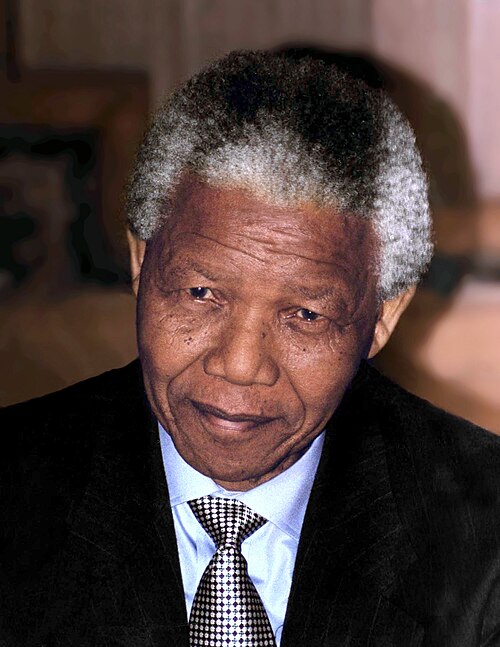
Photo: Kingkongphoto & www.celebrity-photos.com from Laurel / Wikimedia Commons, CC BY-SA 2.0. File page
Photos


Freely licensed photos from Wikimedia Commons used in the Wikipedia article about Nelson Mandela. Each caption names the photographer and license.
Early life
Born July 18, 1918 in Mvezo, South Africa.
Source: Wikidata Q8023 (CC0)
Mandela was born on 18 July 1918, in the village of Mvezo in Umtata, then part of South Africa's Cape Province. He was given the forename Rolihlahla, a Xhosa term colloquially meaning "troublemaker", and in later years became known by his clan name, Madiba. His patrilineal great-grandfather, Ngubengcuka, was ruler of the Thembu Kingdom in the Transkeian Territories of South Africa's modern Eastern Cape province.
Source: Wikipedia, “Early life” (CC BY-SA 4.0)
Family
- Spouses: Evelyn Mase (October 5, 1944 to March 19, 1958); Winnie Madikizela-Mandela (June 14, 1958 to March 19, 1996); Graça Machel (July 18, 1998 to December 5, 2013)
- Parents: Gadla Henry Mphakanyiswa, Nosekeni Fanny
- Children: 6
- Notable relatives: Ndileka Mandela
Source: Wikidata Q8023 (CC0)
Mandela was widely considered a charismatic leader, described by biographer Mary Benson as "a born mass leader who could not help magnetising people". He was highly image conscious and sought out fine quality clothes, with many commentators believing that he carried himself in a regal manner. His aristocratic heritage was repeatedly emphasised by supporters, contributing to his "charismatic power".
Source: Wikipedia, “Personal life” (CC BY-SA 4.0)
Public information only.
Education
- University of the Witwatersrand
- University of Fort Hare
- University of South Africa
- University of London
Source: Wikidata Q8023 (CC0)
Career and jobs
Offices and positions
- Secretary General of the Non-Aligned Movement September 2, 1998 to 1999
- President of South Africa May 10, 1994 to June 14, 1999
- member of the National Assembly of South Africa ?
Source: Wikidata Q8023 (CC0)
Political ideology and goals
Party: South African Communist Party (1950 to 1960); African National Congress (1943 to present)
Ideology (Wikidata, person or party): African nationalism, social democracy
Source: Wikidata Q8023 (CC0)
Mandela identified as both an African nationalist, an ideological position he held since joining the ANC, and as a socialist. He was a practical politician, rather than an intellectual scholar or political theorist.
Source: Wikipedia, “Political positions” (CC BY-SA 4.0)
Stated goals and positions
Mandela proposed that they be tried in a third country, which was agreed to by all parties; governed by Scots law, the trial was held at Camp Zeist in the Netherlands in April 1999, and found one of the two men guilty.
Source: Wikipedia, “Foreign policy” (CC BY-SA 4.0)
Defiance Campaign and Transvaal ANC Presidency: 1950–1954
Mandela took Xuma's place on the ANC national executive in March 1950, and that same year was elected national president of the ANCYL. In March, the Defend Free Speech Convention was held in Johannesburg, bringing together African, Indian and communist activists to call a May Day general strike in protest against apartheid and white minority rule.
Source: Wikipedia, “Defiance Campaign and Transvaal ANC Presidency: 1950–1954” (CC BY-SA 4.0)
Presidency of South Africa (1994–1999)
With the election set for 27 April 1994, the ANC began campaigning, opening 100 election offices and orchestrating People's Forums across the country at which Mandela could appear, as a popular figure with great status among black South Africans.
Source: Wikipedia, “Presidency of South Africa (1994–1999)” (CC BY-SA 4.0)
Tenure
The newly elected National Assembly's first act was to formally elect Mandela as South Africa's first black chief executive. His inauguration took place in Pretoria on 10 May 1994, televised to a billion viewers globally.
Source: Wikipedia, “Tenure” (CC BY-SA 4.0)
Foreign policy
Mandela expressed the view that "South Africa's future foreign relations [should] be based on our belief that human rights should be the core of international relations". Following the South African example, Mandela encouraged other nations to resolve conflicts through diplomacy and reconciliation.
Source: Wikipedia, “Foreign policy” (CC BY-SA 4.0)
Post-presidency and final years (1999–2013)
Retiring in June 1999, Mandela aimed to lead a quiet family life, divided between Johannesburg and Qunu. Although he set about authoring a sequel to his first autobiography, to be titled The Presidential Years, it remained unfinished and was only published posthumously in 2017.
Source: Wikipedia, “Post-presidency and final years (1999–2013)” (CC BY-SA 4.0)
As reported in the Wikipedia article and its cited sources. Allegations are not findings unless a court or official body says so.
Congress of the People and the Treason Trial: 1955–1961
After taking part in the unsuccessful protest to prevent the forced relocation of all black people from the Sophiatown suburb of Johannesburg in February 1955, Mandela concluded that violent action would prove necessary to end apartheid and white minority rule. On his advice, Sisulu requested weaponry from the People's Republic of China, which was denied.
Source: Wikipedia, “Congress of the People and the Treason Trial: 1955–1961” (CC BY-SA 4.0)
Arrest and Rivonia trial: 1962–1964
On 5 August 1962, police captured Mandela along with fellow activist Cecil Williams near Howick. Many MK members suspected that the authorities had been tipped off with regard to Mandela's whereabouts, although Mandela himself gave these ideas little credence.
Source: Wikipedia, “Arrest and Rivonia trial: 1962–1964” (CC BY-SA 4.0)
Public image
Various sources have highlighted Mandela's moral leadership in rehabilitating South Africa's stature in the wider world. By the time of his death, within South Africa Mandela was widely considered "the father of the nation" and "the founding father of democracy". Outside of South Africa, he was a "global icon", with the scholar of South African studies Rita Barnard describing him as "one of the most revered figures of our time".
Source: Wikipedia, “Legacy” (CC BY-SA 4.0)
How they rose: timeline
Born in Mvezo, South Africa
Joins the African National Congress
Joins the South African Communist Party
Becomes President of South Africa (until June 14, 1999)
Becomes Secretary General of the Non-Aligned Movement (until 1999)
Dies
Source: Wikidata Q8023 (CC0)
BLACKOUT.NETWORK stories (1)
- Nelson Mandela privately revealed that General Constand Viljoen prevented a military coup in South AfricaNov 14, 2026 · rank 4/10
Newest first. Stories older than a week are marked Archive.
Sources
Facts in lists come from Wikidata (CC0). Quoted passages are short excerpts of the English Wikipedia article (CC BY-SA 4.0), each linked to its section, where the original citations are. BLACKOUT.NETWORK does not rank, score or rate people.