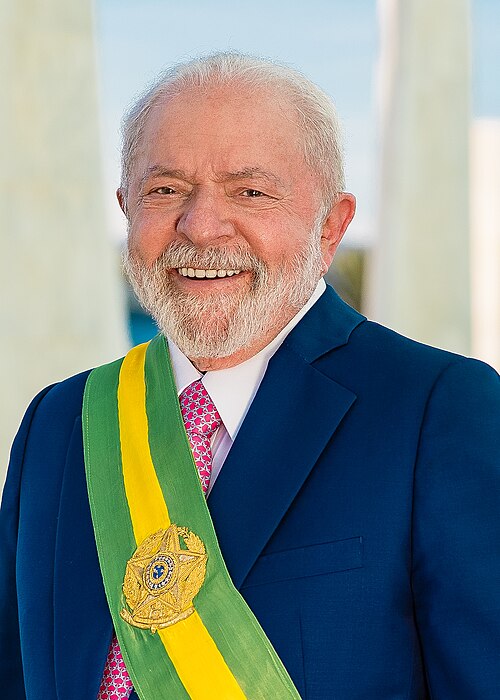
People in the news › Profile
Luiz Inácio Lula da Silva
President of Brazil
- Role
- President of Brazil
- Born
- October 27, 1945, Caetés, Brazil
- Party
- Workers' Party
- Ideology
- Lulism, progressivism, left-wing populism
- Citizenship
- Brazil
- Occupations
- trade unionist, politician, turner, functionary, union member
- Religion
- Catholicism
Luiz Inácio Lula da Silva (born Luiz Inácio da Silva, 27 October 1945), known mononymously as Lula, is a Brazilian politician, trade unionist, and former metalworker who has served as the 39th president of Brazil since 2023. A member of the Workers' Party, he served as the 35th president from 2003 to 2011. Born in Pernambuco, Lula quit school after second grade to work, and did not learn to read until he was 10 years old.
Summary: Wikipedia (CC BY-SA 4.0)
Photo: Palácio do Planalto from Brasilia, Brasil / Wikimedia Commons, CC BY 2.0. File page
Photos


Freely licensed photos from Wikimedia Commons used in the Wikipedia article about Luiz Inácio Lula da Silva. Each caption names the photographer and license.
Early life
Born October 27, 1945 in Caetés, Brazil.
Source: Wikidata Q37181 (CC0)
Luiz Inácio da Silva was born on 27 October 1945 (registered with a date of birth of 6 October 1945) in Caetés (then a district of Garanhuns), 250 km (160 mi) from Recife, capital of Pernambuco, a state in the Northeast of Brazil. He was the seventh of eight children of Aristides Inácio da Silva and Eurídice Ferreira de Melo, farmers who had experienced famine in one of the poorest parts of the agreste. Lula's mother was of Portuguese and partial Italian descent.
Source: Wikipedia, “Early life” (CC BY-SA 4.0)
Family
- Spouses: Rosângela Lula da Silva (May 18, 2022 to present); Maria de Lurdes da Silva (1969 to 1971); Marisa Letícia Lula da Silva (1974 to February 3, 2017)
- Parents: Aristides Inácio da Silva, Dona Lindu
- Children: 2
Source: Wikidata Q37181 (CC0)
Twice a widower, Lula has been married three times, and has a daughter from a fourth relationship. In 1969, he married Maria de Lourdes Ribeiro. She died of hepatitis in 1971 while pregnant with a child, who also died.
Source: Wikipedia, “Personal life” (CC BY-SA 4.0)
Public information only.
Education
Lula had little formal education. He did not learn to read until he was ten years old. He quit school after the second grade to work.
Source: Wikipedia, “Education and work” (CC BY-SA 4.0)
Career and jobs
Offices and positions
- President of Brazil January 1, 2023 to present
- President of Brazil January 1, 2007 to January 1, 2011
- President of Brazil January 1, 2003 to January 1, 2007
- federal deputy of São Paulo February 1, 1987 to February 1, 1991
Source: Wikidata Q37181 (CC0)
Inspired by his brother Frei Chico, a member of the Brazilian Communist Party, Lula joined the labour movement when he worked at Villares Metals, rising through the ranks. He was elected in 1975, and re-elected in 1978, as president of the ABC Metalworkers' Union of São Bernardo do Campo and Diadema. Both cities are located in the ABCD Region, home to most of Brazil's automobile manufacturing facilities, including Ford, Volkswagen, Toyota, and Mercedes-Benz.
Source: Wikipedia, “Union career” (CC BY-SA 4.0)
Political ideology and goals
Party: Workers' Party (February 10, 1980 to present)
Ideology (Wikidata, person or party): Lulism, progressivism, left-wing populism, democratic socialism, market socialism, communism
Source: Wikidata Q37181 (CC0)
Lula has advocated "socialism of the 21st century", but Lulism, his ideology, is considered to be substantially similar to social liberalism. Although he showed a moderate centre-left liberal tendency economically, he highlighted his closeness with the Bolivarian Republic of Venezuela and negatively evaluated Juan Guaidó during the Venezuelan crisis. He is "personally against" abortion, but maintains that it should be treated as a public health issue.
Source: Wikipedia, “Political positions and philosophy” (CC BY-SA 4.0)
First presidency (2003–2011)
Lula, described as left-wing, served two terms as president from 2003 through 2010. During his farewell speech, he said he felt a burden to prove that he could handle the presidency despite his humble beginnings.
Source: Wikipedia, “First presidency (2003–2011)” (CC BY-SA 4.0)
Foreign policy
In 1979, Lula was asked in an interview which historical figures he admired most. He answered: Gandhi, Che Guevara, and Mao Zedong.
Source: Wikipedia, “Foreign policy” (CC BY-SA 4.0)
Second presidency (2023–present)
In May 2021, Lula said that he would run for a third term in the October 2022 general election, against the incumbent President Jair Bolsonaro. He was 17% ahead of Bolsonaro in a poll in January 2022.
Source: Wikipedia, “Second presidency (2023–present)” (CC BY-SA 4.0)
Tenure
Lula said that his main commitments were: the reconstruction of the country in the face of the economic crisis; democracy, sovereignty and peace; economic development and stability; fighting poverty; education; implementation of a National System of Culture and the expansion of housing programmes.
Source: Wikipedia, “Tenure” (CC BY-SA 4.0)
As reported in the Wikipedia article and its cited sources. Allegations are not findings unless a court or official body says so.
Corruption scandals and legal challenges
Lula's administration was plagued by numerous corruption scandals, notably the Mensalão $50 million vote-buying scandal and Escândalo dos sanguessugas during Lula's first term. In the 2005 Mensalão $50 million vote-buying scandal, Brazilian attorney general Álvaro Augusto Ribeiro Costa presented charges against 40 politicians and officials involved in the Mensalão affair, including several charges against Lula himself.
Source: Wikipedia, “Corruption scandals and legal challenges” (CC BY-SA 4.0)
Mensalão vote-buying scandal
In the 2005 Mensalão $50 million vote-buying scandal, Brazilian attorney general Álvaro Augusto Ribeiro Costa presented charges against 40 politicians and officials involved in the Mensalão affair, including several charges against Lula himself. Lula said that he knew nothing about the scandals.
Source: Wikipedia, “Mensalão vote-buying scandal” (CC BY-SA 4.0)
Operation Car Wash: corruption investigation and prosecution
In 2014, Brazil began Operação Lava Jato (English: Operation Car Wash), resulting in multiple arrests and convictions, including nine suits against Lula.
Source: Wikipedia, “Operation Car Wash: corruption investigation and prosecution” (CC BY-SA 4.0)
How they rose: timeline
Born in Caetés, Brazil
Joins the Workers' Party
Becomes federal deputy of São Paulo (until February 1, 1991)
Becomes President of Brazil (until January 1, 2007)
Becomes President of Brazil (until January 1, 2011)
Becomes President of Brazil
Source: Wikidata Q37181 (CC0)
BLACKOUT.NETWORK stories (3)
- Canadian PM Mark Carney: As for the meeting involving Putin, Trump and Xi, it was an idea from Lula. He told me yesterday that he had encouraged this…Nov 16, 2026 · rank 2/10
- A fool like Ellis is incapable of understanding the power of the nationalist mobilization kicked off by Brazil’s youth!Nov 14, 2026 · rank 4/10
- Brazilian President Luiz Inácio Lula da Silva (PT) met with Iranian President Masoud Pezeshkian in a bilateral meeting on the sidelines of the 31st…Nov 13, 2026 · rank 1/10
Newest first. Stories older than a week are marked Archive.
Sources
Facts in lists come from Wikidata (CC0). Quoted passages are short excerpts of the English Wikipedia article (CC BY-SA 4.0), each linked to its section, where the original citations are. BLACKOUT.NETWORK does not rank, score or rate people.