People in the news › Profile
Garry Kasparov
Russian chess grandmaster and activist
- Role
- Russian chess grandmaster and activist
- Born
- April 13, 1963, Baku, Azerbaijan
- Party
- Solidarnost
- Ideology
- liberal democracy, federalism
- Citizenship
- Russia, Croatia, Soviet Union
- Occupations
- chess player, politician, writer, journalist, critic
Garry Kimovich Kasparov (born Garik Kimovich Weinstein on 13 April 1963) is a Russian chess grandmaster, political activist and writer, who was the World Chess Champion from 1985 to 2000. His peak FIDE chess rating of 2851, achieved in 1999, was the highest recorded until being surpassed by Magnus Carlsen in 2013. From 1984 until his retirement from regular competitive chess in 2005, Kasparov was ranked the world's No. 1 player for a record 255 months overall.
Summary: Wikipedia (CC BY-SA 4.0)
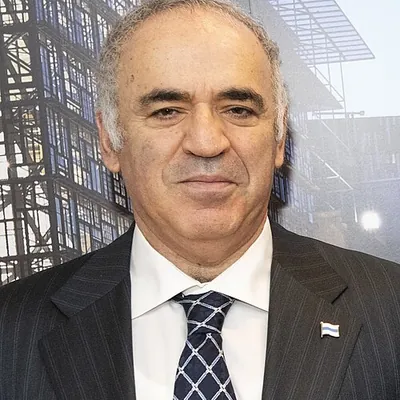
Photo: Lukasz Kobus / Wikimedia Commons, CC BY 4.0. File page
Photos


Freely licensed photos from Wikimedia Commons used in the Wikipedia article about Garry Kasparov. Each caption names the photographer and license.
Early life
Born April 13, 1963 in Baku, Azerbaijan.
Source: Wikidata Q28614 (CC0)
Kasparov was born Garik Kimovich Weinstein (Russian: Гарик Кимович Вайнштейн, romanized: Garik Kimovich Vainshtein) in Baku, Azerbaijan SSR (now Azerbaijan), Soviet Union. His father, Kim Moiseyevich Weinstein, was Jewish and his mother, Klara Shagenovna Kasparova, was Armenian. Both of his mother's parents were Armenians from Karabakh.
Source: Wikipedia, “Early life” (CC BY-SA 4.0)
Family
- Notable relatives: Moisei Vainshtein
Source: Wikidata Q28614 (CC0)
Kasparov has been married three times: to Masha, with whom he had a daughter, Polina, before divorcing; to Yulia, with whom he had a son, Vadim, before their 2005 divorce; and to Daria (Dasha), with whom he has two children, daughter Aida born in 2006 and son Nickolas born in 2015. Kasparov's wife manages his business activities worldwide through Kasparov International Management Inc. He has lived in New York City since 2013.
Source: Wikipedia, “Personal life” (CC BY-SA 4.0)
Public information only.
Education
- Azerbaijan University of Languages (1986)
Source: Wikidata Q28614 (CC0)
Career and jobs
In early 1978, Kasparov participated in the Sokolsky Memorial tournament in Minsk. Normally only established masters and local players were invited, but he received a special invitation, and took first place. Kasparov said that after the victory, he thought he had a "very good shot" at the world championship.
Source: Wikipedia, “Chess career” (CC BY-SA 4.0)
Political ideology and goals
Party: Solidarnost (December 2008 to present); Democratic Party of Russia (1990 to present); Communist Party of the Soviet Union (1984 to 1990); United Civil Front; Committee 2008; Russian Opposition Coordination Council
Ideology (Wikidata, person or party): liberal democracy, federalism
Source: Wikidata Q28614 (CC0)
For full details of Kasparov's involvement in politics in Russia – membership of the Communist Party (1984–1991), his role in the establishment of several pro-democracy movements, leaving Russia in 2013 and subsequent opposition from exile to the regime of Vladimir Putin – and his thoughts on a number of international conflicts and questions, including the Yugoslav Wars of the 1990s, the Nagorno-Karabakh conflict in Armenia, the conflict in the Middle East, Catalan independence and the Gaza genocide, see the Political views of Garry Kasparov. Kasparov had maintained a summer home in the Croatian city of Makarska.
Source: Wikipedia, “Politics and political views” (CC BY-SA 4.0)
Candidate for FIDE presidency
On 7 October 2013, Kasparov announced his candidacy for World Chess Federation president during a reception in Tallinn, Estonia, where the 84th FIDE Congress took place. He was supported by reigning world champion and FIDE No. 1 ranked player Carlsen.
Source: Wikipedia, “Candidate for FIDE presidency” (CC BY-SA 4.0)
Public image
Kasparov received a Chess Oscar eleven times as the best chess player of the year, in 1982–1983, 1985–1988, 1995–1996, 1999 and 2001–2002. He was also awarded the Marca Leyenda trophy in 1997. Between 1981 and 1991, he won or tied for first place in every tournament he entered.
Source: Wikipedia, “Assessment and legacy” (CC BY-SA 4.0)
How they rose: timeline
Born in Baku, Azerbaijan
Joins the Communist Party of the Soviet Union
Completes studies at Azerbaijan University of Languages
Joins the Democratic Party of Russia
Joins the Solidarnost
Source: Wikidata Q28614 (CC0)
BLACKOUT.NETWORK stories (1)
- Garry Kasparov canceled his trip to Berlin due to a threat of an assassination attemptNov 11, 2026 · rank 7/10Archive
Newest first. Stories older than a week are marked Archive.
Sources
Facts in lists come from Wikidata (CC0). Quoted passages are short excerpts of the English Wikipedia article (CC BY-SA 4.0), each linked to its section, where the original citations are. BLACKOUT.NETWORK does not rank, score or rate people.