People in the news › Profile
Fidel Castro
Cuban politician, author and revolutionary
- Role
- Cuban politician, author and revolutionary
- Born
- August 13, 1926, Birán, Cuba
- Died
- November 25, 2016
- Party
- Communist Party of Cuba
- Ideology
- Castroism, communism, Marxism–Leninism
- Citizenship
- Cuba
- Occupations
- politician, lawyer, partisan, journalist, revolutionary
- Religion
- agnosticism
Fidel Alejandro Castro Ruz (13 August 1926 – 25 November 2016) was a Cuban revolutionary and politician who was the leader of Cuba from 1959 to 2011. He served as prime minister from 1959 to 1976, president from 1976 to 2008, and first secretary of the Communist Party of Cuba from 1965 until 2011. Ideologically a Marxist–Leninist and Cuban nationalist, under his administration Cuba became a one-party communist state; industry and business were nationalized, and socialist reforms were implemented throughout society.
Summary: Wikipedia (CC BY-SA 4.0)
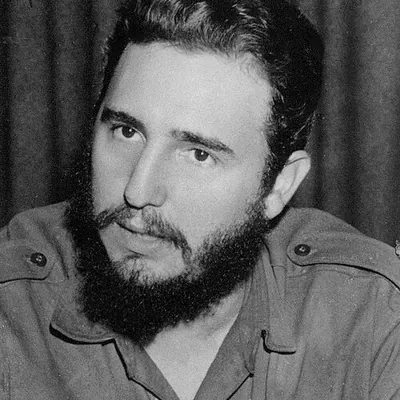
Photo: Unknown (Mondadori Publishers) / Wikimedia Commons, Public domain. File page
Photos


Freely licensed photos from Wikimedia Commons used in the Wikipedia article about Fidel Castro. Each caption names the photographer and license.
Early life
Born August 13, 1926 in Birán, Cuba.
Source: Wikidata Q11256 (CC0)
Fidel Alejandro Castro Ruz was born out of wedlock at his father's farm on 13 August 1926. His father, Ángel Castro y Argiz, was a migrant to Cuba from Galicia, northwest Spain. After the collapse of his first marriage he took his household servant, Lina Ruz González—of Canarian ancestry—as his mistress and later second wife; together they had seven children, among them Fidel.
Source: Wikipedia, “Early life and career” (CC BY-SA 4.0)
Family
- Spouses: Mirta Díaz-Balart (October 11, 1948 to 1955); Dalia Soto del Valle (1980 to 2016)
- Parents: Ángel Castro y Arguíz, Lina Ruz González
- Children: 9
Source: Wikidata Q11256 (CC0)
Castro's religious beliefs have been a matter of some debate; he was baptized and raised as a Catholic.
Source: Wikipedia, “Personal life” (CC BY-SA 4.0)
Public information only.
Education
- Belen Jesuit Preparatory School (1945)
- University of Havana (September 1950)
Source: Wikidata Q11256 (CC0)
Career and jobs
Offices and positions
- Secretary General of the Non-Aligned Movement September 16, 2006 to February 24, 2008
- Secretary General of the Non-Aligned Movement September 10, 1979 to March 6, 1983
- President of Cuba December 2, 1976 to February 24, 2008
- First Secretary of the Communist Party of Cuba June 24, 1961 to April 19, 2011
- Prime Minister of Cuba February 16, 1959 to February 24, 2008
Source: Wikidata Q11256 (CC0)
Castro co-founded a legal partnership that primarily catered to poor Cubans, albeit it proved a financial failure. Caring little for money or material goods, Castro failed to pay his bills; his furniture was repossessed and electricity cut off, distressing his wife. He took part in a high school protest in Cienfuegos in November 1950, fighting with police to protest the Education Ministry's ban on student associations; he was arrested and charged for violent conduct, but the magistrate dismissed the charges.
Source: Wikipedia, “Career in law and politics: 1950–1952” (CC BY-SA 4.0)
Political ideology and goals
Party: Communist Party of Cuba (October 3, 1965 to present); United Party of the Cuban Socialist Revolution (March 26, 1962 to October 3, 1965); Integrated Revolutionary Organizations (July 1961 to March 26, 1962); 26th of July Movement (1955 to 1965); Party of the Cuban People – Orthodox
Ideology (Wikidata, person or party): Castroism, communism, Marxism–Leninism, Guevarism
Source: Wikidata Q11256 (CC0)
Castro proclaimed himself to be "a Socialist, a Marxist, and a Leninist", and publicly identified as a Marxist–Leninist from December 1961 onward. Castro sought to transform Cuba from a capitalist state to a socialist society and ultimately to a communist society. Influenced by Guevara, he suggested that Cuba could evade most stages of socialism and progress straight to communism.
Source: Wikipedia, “Ideology” (CC BY-SA 4.0)
Stated goals and positions
On 9 April, Castro announced that the elections, which the 26th of July Movement had promised would occur after the revolution, would be postponed, so that the provisional government could focus on domestic reform.
Source: Wikipedia, “Consolidating leadership: 1959” (CC BY-SA 4.0)
In response, Castro held a rally where he called for the reintroduction of revolutionary tribunals to try Matos and Diaz for treason.
Source: Wikipedia, “Consolidating leadership: 1959” (CC BY-SA 4.0)
He advocated hard work, family values, integrity, and self-discipline.
Source: Wikipedia, “Ideology” (CC BY-SA 4.0)
Provisional government
At Castro's command, the politically moderate lawyer Manuel Urrutia Lleó was proclaimed provisional president, but Castro announced falsely that Urrutia had been selected by "popular election". Most of Urrutia's cabinet were MR-26-7 members.
Source: Wikipedia, “Provisional government” (CC BY-SA 4.0)
Consolidating leadership: 1959
At Castro's command, the politically moderate lawyer Manuel Urrutia Lleó was proclaimed provisional president, but Castro announced falsely that Urrutia had been selected by "popular election". Most of Urrutia's cabinet were MR-26-7 members.
Source: Wikipedia, “Consolidating leadership: 1959” (CC BY-SA 4.0)
Constitutional government
Up until 1976, Cuba had been managed by a provisional government, headed by Fidel Castro, without a constitution. Cuba then adopted a new constitution in 1976, based on the 1936 Soviet Constitution.
Source: Wikipedia, “Constitutional government” (CC BY-SA 4.0)
Supporters and critics
One of the most controversial political leaders of his era, Castro inspired and dismayed people around the world during his lifetime. He ruled a single-party authoritarian regime in Cuba where political opposition was not permitted. Censorship of information was extensive, and independent journalism was repressed.
Source: Wikipedia, “Reception and legacy” (CC BY-SA 4.0)
What supporters say
Indian prime minister Narendra Modi termed him "one of the most iconic personalities of the 20th century" and a "great friend", while South African president Jacob Zuma praised Castro for aiding black South Africans in "our struggle against apartheid".
Source: Wikipedia, “Reception and legacy” (CC BY-SA 4.0)
What critics say
Various Western governments and human rights organizations nevertheless heavily criticized Castro and he was widely reviled in the US.
Source: Wikipedia, “Reception and legacy” (CC BY-SA 4.0)
Anti-Castro dissidents accused him of committing gang-related assassinations at the time, but these accusations remain unproven.
Source: Wikipedia, “Youth: 1926–1947” (CC BY-SA 4.0)
How they rose: timeline
Born in Birán, Cuba
Completes studies at Belen Jesuit Preparatory School
Completes studies at University of Havana
Joins the 26th of July Movement
Becomes Prime Minister of Cuba (until February 24, 2008)
Becomes First Secretary of the Communist Party of Cuba (until April 19, 2011)
Joins the Integrated Revolutionary Organizations
Joins the United Party of the Cuban Socialist Revolution
Joins the Communist Party of Cuba
Becomes President of Cuba (until February 24, 2008)
Becomes Secretary General of the Non-Aligned Movement (until March 6, 1983)
Becomes Secretary General of the Non-Aligned Movement (until February 24, 2008)
Dies
Source: Wikidata Q11256 (CC0)
BLACKOUT.NETWORK stories (1)
- The Many Assassination Attempts on Fidel CastroNov 13, 2026 · rank 4/10
Newest first. Stories older than a week are marked Archive.
Sources
Facts in lists come from Wikidata (CC0). Quoted passages are short excerpts of the English Wikipedia article (CC BY-SA 4.0), each linked to its section, where the original citations are. BLACKOUT.NETWORK does not rank, score or rate people.